My husband is away in Arkansas for some military training that includes, much to my liking, some history lessons as well. He's been studying the Little Rock Nine, so I decided to study a similar situation that happened in Birmingham.
Segreation was at it's height in the South and racial tensions were only escalating in Birmingham, AL when Governor George Wallace and President John F. Kennedy crossed lines that will forever be drawn in history.
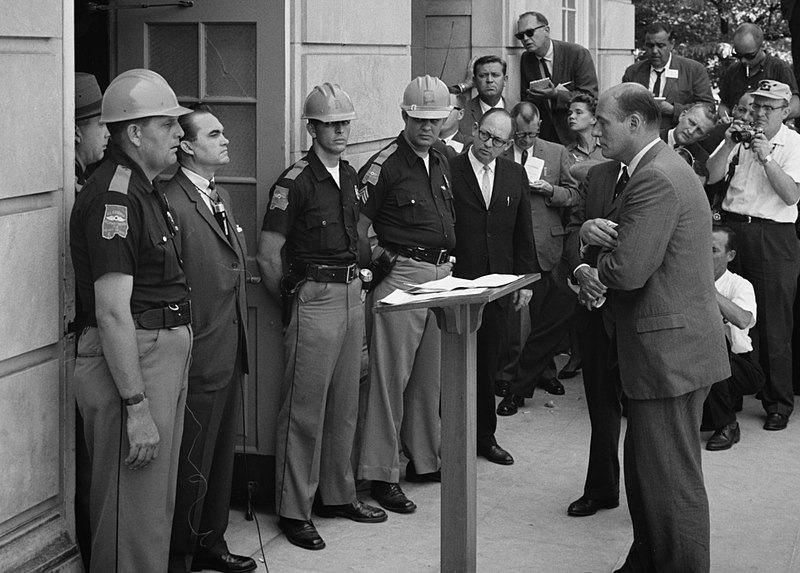
JFK and Wallace had a conversation on May 18, 1963 regarding the situation in Birmingham just a few weeks before Wallace's famous "stand in the schoolhouse door" stint on June 11, 1963 aimed at preventing Vivian Malone and James Hood, two black students, from successfully enrolling at the University of Alabama.

 JFK realized the importance of these moments and seemed to handle Gov. Wallace with care and concern. As you can see, moments of diplomacy like that leave a lasting legacy. Check out the memorandum that was created to document their conversation. Gov. Wallace regarded Martin Luther King as a "faker" who was in a competition with the Rev. Shuttlesworth to see "...who could go to bed with the most n****r women, and white and red women too. They ride around town in big Cadillacs smoking expensive cigars." In later conversations, Wallace would be quoted as saying, "The President wants us to surrender this state to Martin Luther King and his group of pro-Communists who have instituted these demonstrations."
(Didn't he mean pro-Cadillacs? Sorry for the diversion.) Clearly, Gov. Wallace was a segregationist of immense concern.
 We can infer that Kennedy knew Wallace was a stubborn man, to say the least. So, he took it upon himself to create some preliminary notes about how to handle the upcoming attempt to enroll two black students at the University of Alabama. Here is a copy of JFK's handwritten notes.
But it's never notes or diplomacy that get us to change. It's learning from one's own personal history and finally reconciling it to the past. Gov. Wallace was able to move forward with his life by realizing ["...he needed to seek love and forgiveness. In 1979, as blacks began voting in large numbers in Alabama, Wallace said of his stand in the schoolhouse door: "I was wrong. Those days are over and they ought to be over."]
My reason for posting this here today is taken in part from my interest in learning about the first-hand accounts of the Civil Rights era, and to remind us all that "Those who do not learn from history are doomed to repeat it." - George Santayana, Spanish born American Philosopher.

No comments:
Post a Comment